
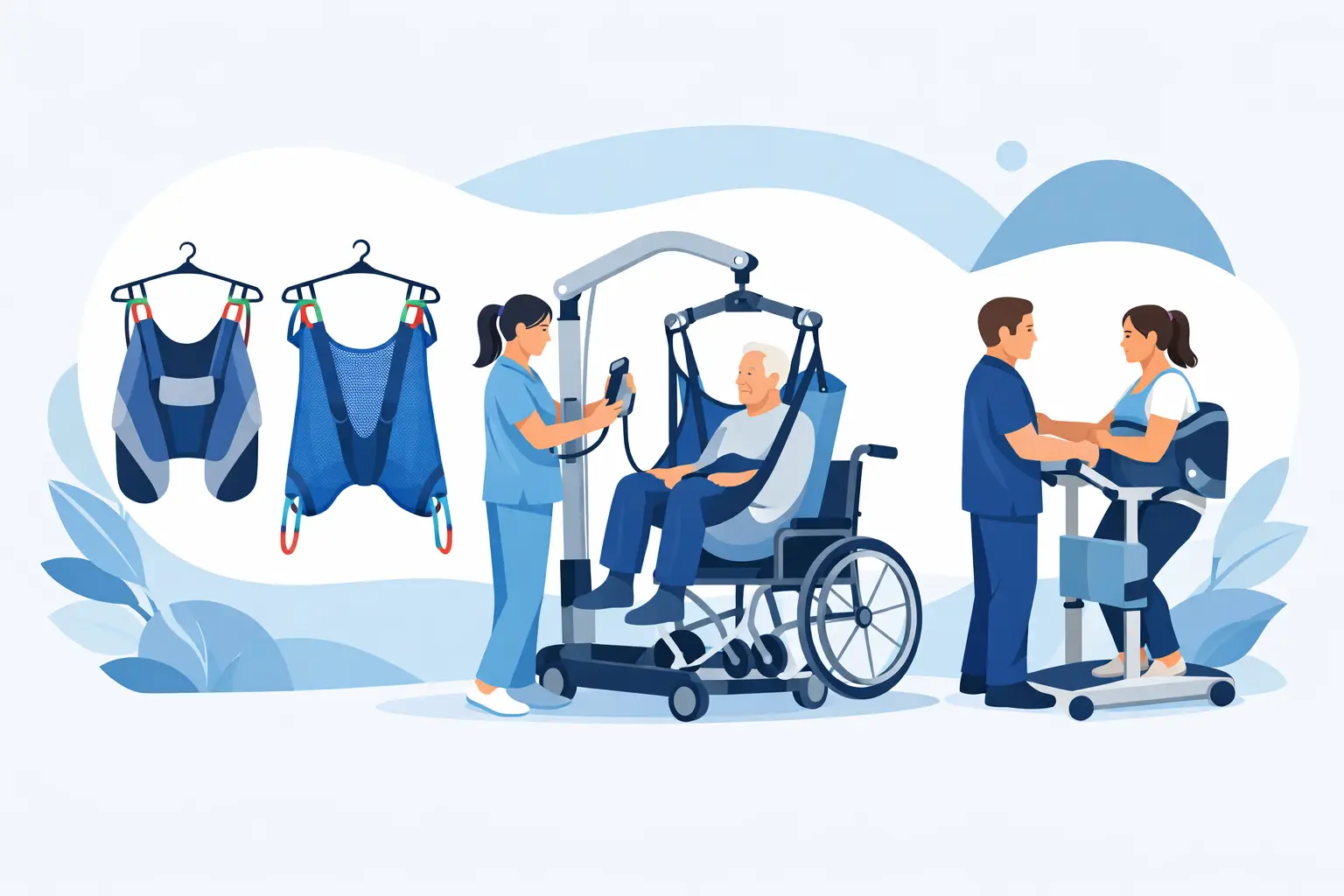
Patient Lift Slings Types Explained
A lift can work perfectly and still be the wrong transfer solution if the sling is not matched to the patient, task, and care setting. When buyers compare patient lift slings types, they are usually trying to solve a practical problem – safer transfers, better positioning, easier toileting access, or improved support for a patient whose needs have changed.
That is why sling selection should never be treated as a small accessory decision. In homecare, the wrong sling can make routine transfers harder for family caregivers. In long-term care and clinical settings, it can affect comfort, skin protection, staff efficiency, and transfer safety across repeated daily use. The goal is not to find a “best” sling in the abstract. The goal is to find the right sling for the patient’s mobility level, body shape, medical condition, and transfer environment.
The main patient lift slings types
Most patient lift slings types fall into a few functional categories. The differences are not cosmetic. They determine how much of the body is supported, whether hygiene access is available, and how stable the patient feels during transfer.
Full body slings
A full body sling supports the head, trunk, pelvis, and thighs. This is one of the most common choices for patients with limited trunk control, minimal weight-bearing ability, or a higher need for total assistance. It is often used with manual hydraulic lifts and powered patient lifts in both facilities and home settings.
For many caregivers, this is the most forgiving sling category because it provides broad support. It can reduce the sense of instability during lifting and may be appropriate for transfers from bed to chair, chair to commode, or floor to bed, depending on the design. The trade-off is that it can be less convenient for toileting and clothing management than more open sling styles.
U-shape slings
U-shape slings, sometimes called universal slings, wrap under the thighs and around the back without requiring the patient to remain fully reclined inside a full hammock-style support. They are widely used because they balance support with easier application.
This style can work well for many general transfers, especially when the patient has some head and trunk control or when a version with head support is selected. However, fit matters a great deal. If the sling is too large, the patient may slump. If it is too small, pressure and positioning problems can develop quickly.
Toileting slings
Toileting slings are designed with an open area that allows access for clothing removal and hygiene tasks. They are useful when the transfer itself is not the only issue – the care task after the transfer matters just as much.
These slings usually support the torso while leaving more of the seat area open. That makes them practical for commode transfers and bathroom routines, but they are not right for every patient. Someone with poor trunk stability, significant involuntary movement, or high anxiety during transfers may need more support than a toileting sling provides.
Stand-assist slings
Stand-assist slings are used with sit-to-stand lifts rather than full patient lifts. They are intended for patients who can bear some weight, follow instructions, and participate in the transfer. Instead of cradling the body, they support the torso during a standing or pivot-style assisted movement.
This is an important distinction because a stand-assist sling is not interchangeable with a full body sling. If a patient cannot safely engage their legs or maintain enough postural control, moving to a sit-to-stand system can create risk instead of efficiency.
Bariatric slings
Bariatric slings are built for higher weight capacities and larger body dimensions. The best option is not simply the sling with the highest capacity. Width, leg support design, reinforced materials, and compatibility with the lift frame all matter.
For bariatric care, the sling and lift must be evaluated as a system. A bariatric sling on a standard lift does not create a bariatric-safe transfer setup. Capacity limits, spreader bar dimensions, patient girth, and transfer path clearance all need to be confirmed before purchase.
How support level changes sling choice
The fastest way to narrow options is to ask how much support the patient needs during the lift itself. A patient with little or no head control usually needs a sling with head support. A patient with good upper body strength but poor lower body stability may do well with a different style than someone who is fully dependent.
Functional ability matters more than diagnosis alone. Two patients with the same condition may need different sling types because one can sit upright reliably and the other cannot. Procurement teams and caregivers should also consider whether the patient becomes fatigued at certain times of day, since transfer ability can change between morning and evening.
Material options and why they matter
Sling material affects comfort, drying time, skin management, and how the sling performs during repeated use. This is often overlooked during first-time buying.
Padded fabric
Padded fabric slings are commonly used for general transfers. They provide a comfortable feel and can be suitable for extended seated positioning during the transfer. In many care settings, they are the default option for routine bed-to-chair movement.
The trade-off is moisture management. If toileting or bathing is part of the care plan, a padded fabric sling may not be the most practical choice.
Mesh slings
Mesh slings are often preferred for bathing and shower use because they drain and dry more quickly. They can also be useful when a sling may remain in place briefly after transfer, depending on the patient and manufacturer guidance.
That said, mesh is not automatically better for every patient. Some patients prefer the feel and perceived security of a more substantial fabric, particularly if they are anxious during lifting.
Disposable and specialty materials
Some environments use disposable slings for infection control protocols or single-patient use plans. Specialty materials may also be selected for skin sensitivity, repositioning, or specific clinical requirements.
These choices tend to be setting-driven. A homecare buyer may prioritize washability and comfort, while a facility may weigh laundering workflow, inventory turnover, and patient-specific assignment policies.
Sizing is not a small detail
A sling that is the wrong size can undermine an otherwise appropriate product choice. Sizing affects posture, pressure distribution, and how securely the patient is positioned once suspended.
Manufacturers use different sizing systems, so a medium in one brand may not fit like a medium in another. Weight is part of the equation, but it should not be the only measurement used. Hip width, torso length, thigh circumference, and head support needs can all affect fit. For institutional buyers standardizing inventory, this is one reason product consistency matters. For home users replacing an existing sling, matching the original dimensions and loop configuration is often safer than guessing by label alone.
Clip, loop, and compatibility issues
Not every sling works with every lift. This point deserves careful attention because compatibility errors are common when replacing worn slings or sourcing from multiple vendors.
Some slings use chain or clip attachments. Others use loop-style connections with several color-coded positions to adjust seating angle. The attachment method has to match the lift’s carry bar or spreader bar design. Even when a sling can be physically attached, that does not mean it has been validated for safe use with that lift.
For procurement teams, standardization reduces confusion. For homecare purchasers, expert confirmation is worth the extra step before ordering, especially if the original sling label is faded or missing.
Choosing for homecare versus facility use
The same patient may need a different sling strategy depending on where care is happening. In homecare, ease of application and caregiver confidence are often decisive. A sling that performs well in a facility with trained staff may feel difficult for a family caregiver working alone in a tight bedroom.
In long-term care and hospital-related settings, durability, laundering cycles, and availability of multiple sizes often carry more weight. Toileting frequency, room turnover, and staff workflow can influence which sling categories are stocked most heavily. Government and institutional buyers may also need to account for documentation, product consistency, and broader compliance requirements across many users.
When a reassessment is needed
A sling that worked six months ago may not be right now. Weight change, posture change, surgery, new contractures, decline in trunk control, and skin integrity concerns can all affect sling suitability.
Reassessment is also wise when transfers become harder than usual, the patient appears less centered in the sling, or caregivers start avoiding a certain transfer because it feels unstable. Those are not minor inconveniences. They are signals that the sling, lift, or care plan may need review.
The best sling choice is usually the one that makes the transfer safer, more predictable, and less physically demanding for everyone involved. If you are comparing patient lift slings types for a home setup, a facility order, or a product replacement, it helps to start with the transfer task first and the catalog second. A knowledgeable equipment partner such as DME Medical Supplies can help confirm fit, compatibility, and use case before that decision turns into a daily problem.