
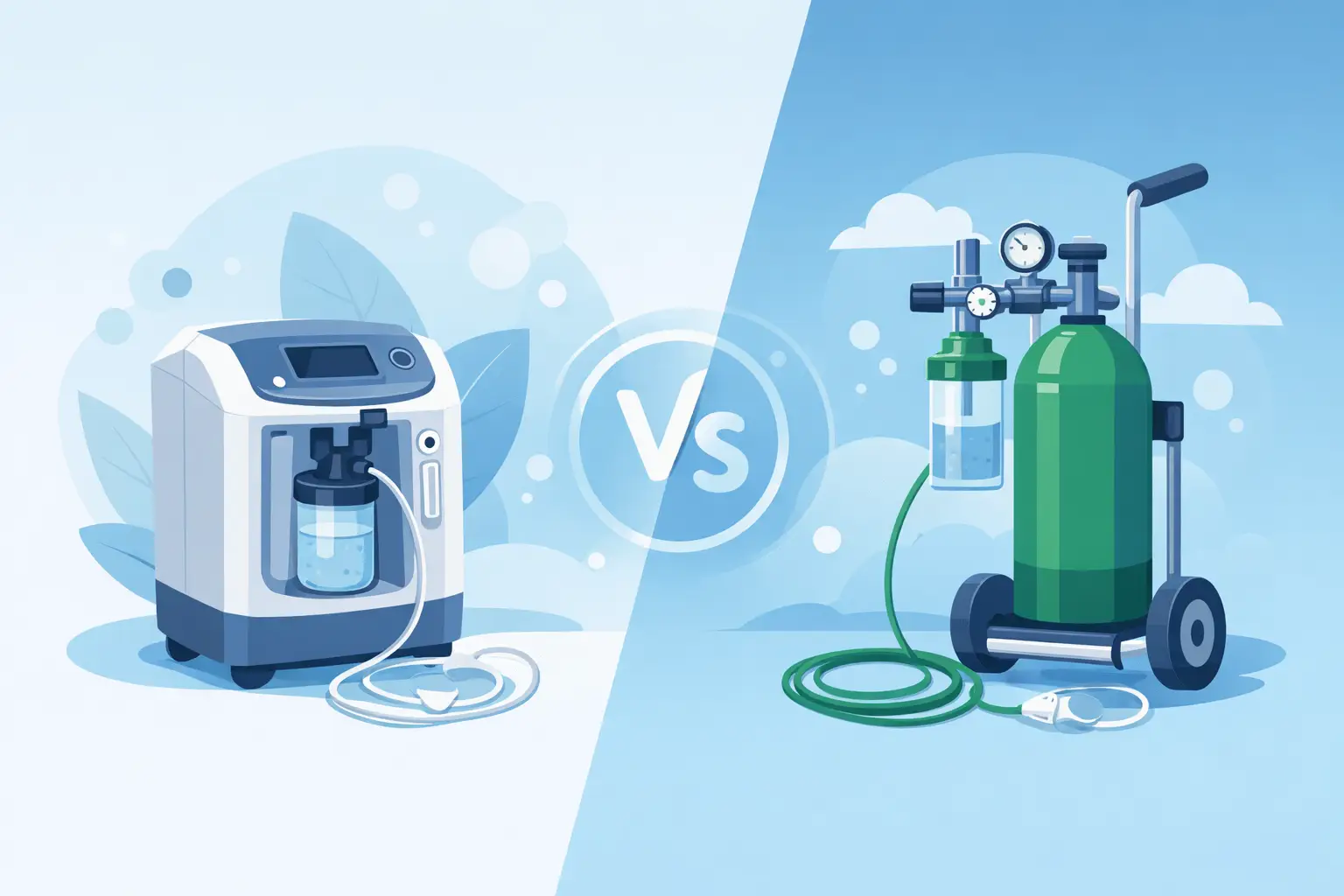
Oxygen Concentrator Versus Oxygen Tank Compared
A missed oxygen delivery, a power outage, or a patient whose needs change after discharge can quickly turn a routine equipment decision into an urgent care problem. Choosing an oxygen concentrator versus oxygen tank requires more than comparing device size or purchase price. The right choice depends on the prescribed flow, the patient’s mobility, the care setting, available backup equipment, and the team’s ability to manage deliveries, power, and safety.
Both systems can provide prescribed supplemental oxygen. They operate differently, however, and each has practical advantages that matter in homes, long-term care settings, post-acute transitions, and respiratory equipment programs.
How each oxygen system works
An oxygen concentrator draws in room air, removes much of the nitrogen, and delivers concentrated oxygen through tubing and a nasal cannula or other prescribed interface. A stationary concentrator runs on household electricity and is designed to provide oxygen continuously while the patient is at home, in a room, or in a care facility. Many stationary models are used for continuous-flow therapy, but each unit has a specific flow range that must match the prescription.
Portable oxygen concentrators are smaller battery-powered units intended for use outside the home. Many deliver oxygen in pulse doses, meaning the device senses an inhalation and releases a measured bolus of oxygen. Pulse-dose settings are not the same as continuous-flow liters per minute. A patient who requires continuous flow, has shallow breathing, breathes through the mouth, or needs higher flow may not be adequately supported by every portable concentrator.
An oxygen tank stores oxygen under pressure. Common compressed-gas cylinders range from small portable cylinders to larger home backup cylinders. Unlike a concentrator, a tank does not require electricity to produce oxygen at the point of use. It requires a regulator, appropriate tubing, and careful monitoring of the remaining supply. The amount of usable time depends on cylinder size, starting pressure, prescribed flow, and whether the patient uses continuous flow or a conserving device.
Oxygen concentrator versus oxygen tank: practical differences
The most significant operational difference is supply continuity. A concentrator can continue operating as long as electrical power is available and the machine is functioning correctly. It does not need routine oxygen refills. This makes it well suited for patients who use oxygen for many hours each day, as well as facilities that need to reduce cylinder storage and replacement activity.
A tank has a fixed oxygen supply. Once the cylinder reaches its safe empty point, it must be replaced or refilled through an approved oxygen service process. For a mobile patient, a cylinder can be dependable and simple to use, but the care team must calculate expected duration and plan for delays, longer appointments, traffic, weather, and unexpected higher oxygen use.
Portability is more nuanced than it first appears. Small tanks can be carried in a cylinder bag or secured to a wheelchair, while larger cylinders are usually intended for stationary use. Portable concentrators avoid carrying multiple cylinders, but they add battery management, charging time, and device-specific operating limits. A patient may find one option easier than the other based on strength, dexterity, cognition, travel patterns, and the availability of a caregiver.
Noise is another consideration. Stationary concentrators produce a constant operating sound and warm exhaust air. Many patients adapt well, but the location of the device matters in a bedroom or shared living space. Tanks are quiet during use, although a regulator or conserving device may make a soft sound as oxygen flows.
Start with the prescription and clinical need
Equipment selection should begin with the oxygen order, not with a preferred device type. Confirm the prescribed flow rate, whether oxygen is continuous or pulse dose, the hours of use per day, and whether the need changes during sleep, exertion, or transport. A patient may need a stationary concentrator for overnight continuous flow and a separate portable system for appointments and community mobility.
For institutional purchasers, confirm whether the device will support the anticipated patient population rather than only one current resident. A unit appropriate for low-flow maintenance therapy may not meet the needs of a patient requiring a higher continuous flow. Procurement teams should also account for tubing length, humidification requirements, compatible cannulas, backup cylinders, regulators, carts, and signage as part of the total setup.
Do not assume that a higher number on a pulse-dose portable concentrator equals a matching continuous-flow prescription. The clinician and respiratory care professional should verify that the selected equipment delivers the prescribed therapy under the patient’s actual conditions of use.
Power planning makes concentrators safer to use
A concentrator is often the primary oxygen source at home because it can operate for extended periods without deliveries. Its key dependency is power. Every concentrator user should have a backup plan for outages, including an accessible oxygen cylinder with the correct regulator and enough capacity for the expected emergency period.
Caregivers should know how to recognize the concentrator’s power-loss and low-oxygen alarms, switch to backup oxygen, and contact the appropriate service or emergency resource. The device should be plugged directly into a properly grounded wall outlet unless the manufacturer specifically permits another arrangement. Extension cords, overloaded outlets, and improvised power setups can create safety and reliability concerns.
Facilities should incorporate oxygen-dependent residents into emergency preparedness planning. That includes identifying backup cylinder locations, documenting who can set up the backup equipment, checking cylinder inventory, and accounting for evacuation transport. A generator can support some operations, but teams should verify which outlets and circuits are covered rather than assuming every patient room has emergency power.
Tank management requires disciplined handling
Oxygen itself does not burn, but it makes materials burn faster and more intensely. This applies to concentrator and tank users alike. Keep oxygen equipment away from smoking, vaping, open flames, gas stoves, candles, and heat sources. Do not use petroleum-based lotions or grease around oxygen equipment unless a clinician or manufacturer specifically directs otherwise.
Cylinders must be secured upright in a stand, cart, rack, or approved holder so they cannot fall or roll. A falling cylinder can damage the valve and create a serious hazard. Never leave a tank loose in a vehicle, place it in an enclosed trunk, or attempt to modify the regulator or valve.
For homecare agencies and long-term care teams, cylinder tracking is part of continuity of care. Label full and empty cylinders clearly, inspect regulators and gauges before use, and establish a routine for replacing inventory before it becomes an after-hours issue. Patients and caregivers should be taught to check the gauge rather than estimating supply by how heavy the tank feels.
Cost, delivery, and maintenance considerations
The cost comparison is not limited to the equipment itself. A concentrator involves electricity, routine filter care, preventive service, and eventual repair or replacement. In exchange, it can reduce recurring cylinder deliveries for patients with regular oxygen use. It may be the more operationally efficient primary source for a stable home or resident room with reliable power.
Tanks involve recurring delivery, pickup, refill, or exchange logistics. They may be a practical choice for intermittent oxygen needs, emergency backup, short outings, or situations where electric power is unreliable. They also remain necessary in many care plans even when a concentrator is the main source.
Before ordering, verify the equipment’s flow capabilities, power requirements, battery specifications when applicable, alarm features, warranty terms, service availability, and compatible accessories. For multi-site organizations, standardizing a limited number of approved models can simplify staff training, accessory sourcing, and preventive maintenance.
When a combined setup is the best answer
For many oxygen users, the decision is not concentrator or tank. It is concentrator plus tank. A stationary concentrator can provide dependable daily therapy at home, while a cylinder serves as emergency backup and may support travel to appointments. Some patients also use a portable concentrator for daytime mobility, depending on their prescription and demonstrated tolerance.
This layered approach addresses the main weakness of each system: concentrators depend on power, while tanks have a finite supply. It also gives caregivers a clear alternative when an alarm sounds, a battery is depleted, or a delivery is delayed.
The best oxygen system is the one that consistently meets the prescribed therapy while fitting the patient’s environment and the care team’s ability to manage it. Confirm the clinical requirements first, plan for power loss or supply depletion before equipment arrives, and make sure every caregiver knows how to operate the primary and backup source safely.