
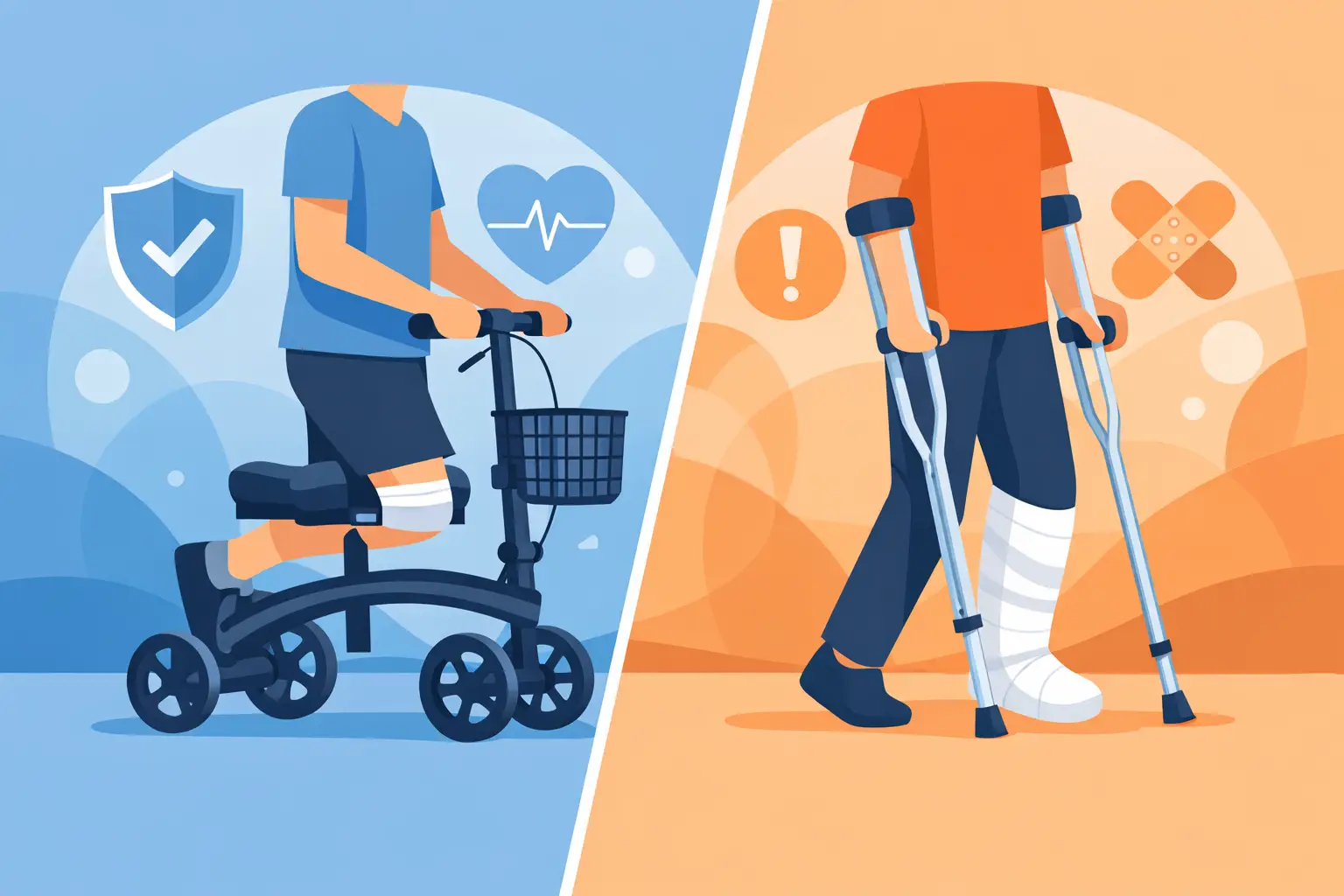
Knee Walker vs Crutches for Safer Recovery
A non-weight-bearing order changes ordinary tasks quickly. Getting from the bedroom to the bathroom, carrying a drink, entering a workplace, or navigating a narrow hallway can become a safety concern. In the knee walker vs crutches decision, the right mobility aid is the one that supports the prescribed weight-bearing restriction while matching the patient’s strength, balance, home layout, and daily responsibilities.
Neither option is automatically better for every injury or care setting. A knee walker can reduce strain on the hands and support more efficient movement on level indoor surfaces. Crutches are often more practical on stairs, in tight spaces, and when storage or transportation is limited. The treating clinician’s instructions should always determine whether either device is appropriate.
Knee Walker vs Crutches: The Core Difference
A knee walker, also called a knee scooter, supports the injured lower leg on a padded platform while the patient propels the device with the unaffected leg. Most models have four wheels, handlebars, hand brakes, and a steering column. This design keeps weight off the injured foot or ankle without requiring the patient to swing both legs forward as they would with crutches.
Crutches transfer body weight through the hands and arms while the injured leg remains off the floor. Standard underarm crutches are widely available and can be adjusted for height. Forearm crutches may offer another option for some long-term users, but they require fitting and training.
The functional difference matters. A knee walker is a rolling device that performs best on firm, relatively smooth surfaces. Crutches are a more compact walking aid that can be used over curbs, stairs, and uneven transitions, but they demand more upper-body strength and coordination.
When a Knee Walker May Be the Better Choice
For a patient recovering from foot, ankle, or lower-leg surgery, a knee walker may be useful when the affected leg must remain completely non-weight-bearing and the person can safely kneel on the opposite leg. It is often a practical choice for single-level homes, school campuses, offices with accessible routes, and facilities with wide hallways and smooth flooring.
Many patients find that a knee walker reduces fatigue during longer indoor distances. Because both hands can remain near the handlebars, the device may feel more stable than crutches for users with good standing balance on the unaffected leg. A basket or bag accessory can also make it easier to transport small personal items, medications, or paperwork. That said, items should never interfere with steering, braking, or the user’s view of the floor.
A knee walker can be especially helpful when hand or wrist discomfort makes crutches difficult. Arthritis, reduced grip strength, shoulder pain, and recovery from an upper-extremity injury can all limit safe crutch use. However, a knee walker is not a hands-free solution. The user still needs adequate balance, vision, reaction time, and the ability to operate the brakes.
Knee walkers have important limitations. They should not be used on stairs, escalators, loose gravel, steep slopes, wet grass, or heavily uneven surfaces. Small thresholds, throw rugs, cords, and clutter can also create a tipping risk. In a home with several stairs between essential rooms, a knee walker may be useful only as part of a broader mobility plan.
When Crutches May Be the Better Choice
Crutches can be the more adaptable option when the patient must regularly manage stairs, narrow doorways, curbs, crowded spaces, or uneven outdoor routes. They fit easily in a vehicle and take up little storage space. For a patient who must travel between multiple levels of a home or facility, crutches may be necessary even if a knee walker is used elsewhere.
They also allow a patient to move through areas where a wheeled device cannot turn safely. This is relevant in older homes, small bathrooms, patient rooms with limited clearance, and job sites where floor conditions vary. When fitted correctly and used with appropriate instruction, crutches can support non-weight-bearing, toe-touch, or partial-weight-bearing plans as ordered by the clinician.
The trade-off is physical demand. Crutches place ongoing stress on the hands, wrists, shoulders, and upper back. Fatigue can lead to poor technique, which increases the risk of falls. Underarm crutches must be adjusted so the underarm pad sits below the armpit rather than pressing into it. The patient should bear weight through the hands, not through the underarms.
Crutches may not be the best primary choice for patients with significant upper-body weakness, painful arthritis, poor balance, dizziness, or certain neurologic conditions. A clinician or physical therapist should evaluate whether the patient can use them safely before relying on them at home.
Match the Device to the Care Environment
The patient’s diagnosis matters, but so does the route they need to travel every day. A mobility aid that works well in a clinic can be impractical in a split-level home. Before selecting equipment, review the environment from the bed to the bathroom, kitchen, entrance, vehicle, and follow-up appointments.
For homecare teams and caregivers, four questions can prevent avoidable problems:
- Are there stairs, raised thresholds, loose rugs, pets, cords, or uneven outdoor surfaces on essential routes?
- Can the patient safely support themselves through their hands and arms, or tolerate kneeling on the unaffected knee?
- Does the prescribed recovery plan require strict non-weight-bearing, or is limited weight-bearing allowed?
- Will the patient need to carry meals, medications, work materials, oxygen equipment, or personal items while moving?
A knee walker may be ideal for traveling across a level first floor, while crutches are reserved for the few steps at an entryway. Some patients need both devices to handle different environments. Others may need a wheelchair for longer distances, periods of fatigue, or situations where neither a knee walker nor crutches can be used safely.
Fit, Setup, and Training Affect Safety
Proper selection is only the first step. A poorly adjusted mobility aid can create pain, loss of control, and unnecessary fall risk. Patients should receive instruction before independent use, particularly after surgery, hospitalization, or a new diagnosis that affects balance or endurance.
With a knee walker, the padded platform should support the injured leg comfortably without forcing the hip to twist or the patient to lean. Handlebar height should allow an upright posture with a comfortable reach to the brakes. The user should test turns slowly, practice stopping, and learn to lock or secure the device before transferring on and off.
With crutches, height and handgrip placement must be adjusted to the patient. The patient should practice the prescribed gait pattern on level ground before trying stairs. Stair technique should be taught directly by a qualified clinician whenever possible because the correct sequence depends on the injury, strength, handrail availability, and weight-bearing order.
For either device, supportive footwear on the unaffected foot is essential. A stable, non-slip shoe can help equalize height and improve traction. Patients should avoid hopping while holding objects, using a phone while moving, or rushing to answer a door or bathroom need.
Consider Recovery Duration and Daily Demands
Short-term use after a minor procedure may favor the simplest device the patient can operate safely. A longer recovery may justify a more detailed evaluation of comfort, transport needs, replacement parts, and storage. Facility buyers and homecare providers should also consider whether the equipment can be cleaned appropriately, adjusted between users when applicable, and supported with readily available accessories.
Knee walkers vary in weight capacity, wheel size, braking systems, folding mechanisms, and indoor or outdoor capability. Crutches vary in material, adjustment range, tip design, and weight capacity. Bariatric users, pediatric patients, and patients with complex rehabilitation needs require equipment matched to their specific measurements and clinical needs rather than a standard one-size selection.
Insurance coverage, rental availability, and delivery timing may also influence the decision. These practical details should not override safety, but they can determine whether a patient has appropriate equipment ready when they return home. For time-sensitive needs, DME Medical Supplies can help customers identify mobility equipment suited to the prescribed use and care environment.
A Practical Decision for Safer Mobility
Choose a knee walker when the patient has a level, accessible route; can safely kneel on the unaffected leg; and needs a less strenuous option for longer indoor distances. Choose crutches when stairs, uneven terrain, narrow passages, or frequent transportation are part of daily life and the patient has the upper-body strength and training to use them correctly.
The most useful mobility aid is the one a patient can operate consistently without compromising the recovery plan. A quick review of the clinician’s order, the patient’s capabilities, and the actual care environment can turn a difficult recovery routine into a safer, more manageable one.