
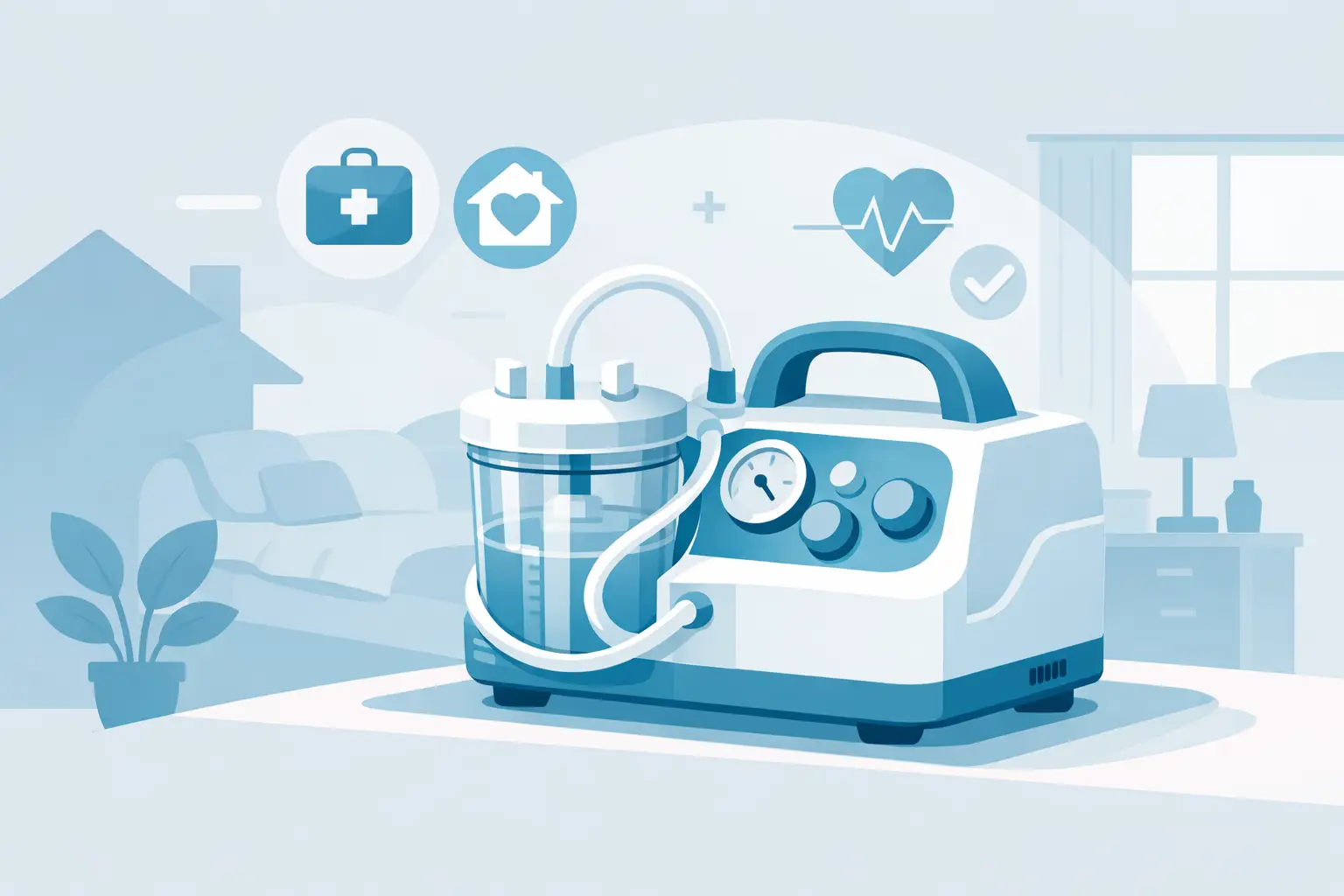
Choosing a Suction Machine for Home Use
A suction machine for home use is rarely a casual purchase. In most cases, it becomes part of a daily care routine where speed, reliability, and ease of operation matter just as much as the product specs. Whether the need is airway secretion management, tracheostomy care, post-operative support, or backup preparedness for a medically complex patient, the right unit has to fit the care setting as well as the clinical need.
For caregivers and homecare buyers, the challenge is not just finding a machine that works. It is choosing one that can be used consistently in the home without creating avoidable problems such as difficult transport, noisy operation, frequent maintenance issues, or accessories that are hard to replace. A good purchasing decision supports continuity of care and reduces stress when suction is needed quickly.
What a suction machine for home use is designed to do
A home suction machine removes fluids, secretions, and small amounts of mucus from the airway or oral cavity when a patient cannot clear them effectively on their own. In the home setting, these devices are commonly used for patients with tracheostomies, neuromuscular conditions, chronic respiratory compromise, swallowing disorders, or recovery needs that affect secretion management.
That basic function sounds straightforward, but home use changes the buying criteria. A hospital wall suction system is stationary and connected to a facility infrastructure. A home unit has to deliver dependable suction performance in a smaller, self-contained format, often with a caregiver operating it outside a clinical environment. That is why practical details such as battery backup, weight, filter access, and noise level carry real importance.
How to evaluate a suction machine for home use
The first question is not simply, “Which model is best?” It is, “What does this patient’s care routine require day to day?” Some users need occasional oral suctioning. Others rely on scheduled or frequent airway suctioning throughout the day and night. The right machine for one situation may be inefficient or overly bulky for another.
Suction strength and adjustability
Suction performance should match the prescribed use. Too little suction can make secretion clearance ineffective. Too much suction may be uncomfortable or inappropriate depending on the application. Adjustable vacuum settings are important because they allow the caregiver to align operation with clinical guidance rather than using a one-level machine for every circumstance.
When comparing units, buyers often focus on maximum suction power alone. That can be misleading. Maximum power matters, but controllability matters too. A machine that reaches the needed pressure but allows stable adjustment is often more useful than one marketed mainly on peak performance.
Portability and footprint
In many homes, care does not happen in one room. The machine may need to move from bedside to living area, travel to appointments, or remain available during transport. If the patient is active or receives care in multiple environments, a compact portable unit may be the better fit.
That said, portability can involve trade-offs. Smaller machines are easier to carry, but they may have smaller canisters, shorter battery duration, or fewer heavy-duty features than larger tabletop designs. For high-frequency use, a slightly larger unit may be the more practical long-term option.
Battery backup versus AC-powered use
A standard AC-powered machine may be appropriate for stable home setups where the device remains near the patient’s primary care area. But if the patient leaves the home regularly, or if backup readiness is a concern, battery operation becomes more important.
For some families, battery backup is not a convenience feature. It is a safety feature. Power interruptions, vehicle transport, and room-to-room movement can all affect care access. Buyers should look closely at whether the machine has internal rechargeable battery capability, external power options, or car adapter compatibility if mobility is part of the care plan.
Canister capacity and overflow protection
Canister size affects how often the caregiver needs to stop and empty the collection container. A smaller canister may be fine for intermittent use, while a larger capacity can reduce interruptions in more demanding care routines.
Overflow protection also deserves attention. This feature helps prevent fluids from entering the pump, which can damage the device and create sanitation concerns. In homecare, where staff support may be limited compared with a facility environment, built-in protection features can help reduce downtime and replacement costs.
Accessories and replacement parts matter more than many buyers expect
A suction machine is only as useful as the full setup around it. Tubing, canisters, filters, suction catheters, connectors, and other consumables all affect continued operation. Buyers sometimes choose a machine based on the base unit alone and only later discover that replacements are difficult to source or that accessory compatibility is limited.
This is where product support becomes part of the purchasing decision. Ongoing home use usually means ongoing resupply. Before selecting a unit, it helps to confirm what parts are routinely replaced, how often they need to be changed, and whether the needed accessories are readily available. That is especially important for organizations managing multiple patients or caregivers supporting discharge-to-home transitions.
Cleaning and maintenance expectations
Home equipment should be manageable for the people actually using it. A machine that performs well on paper but is cumbersome to clean may create compliance problems over time. Clear canister handling, simple exterior cleaning, accessible filter replacement, and straightforward assembly all support safer routine use.
Maintenance needs should also be realistic for the care setting. If the patient has rotating caregivers, simpler operation often reduces errors. If the machine will be used by a trained homecare team, a more advanced unit may still be appropriate, but ease of service remains a benefit.
Matching the machine to the care setting
Not every home environment functions the same way. A private residence with one primary caregiver differs from a group home, home health rotation, pediatric household, or discharge setup where family members are still learning the process. The best purchase usually comes from matching the unit to the care environment, not just the diagnosis.
For a mostly stationary bedside setup, durability, stability, and canister capacity may outweigh ultra-light portability. For pediatric or travel-heavy use, lower weight and battery options may move to the top of the list. For agencies and procurement teams, standardization across units can simplify staff training and parts replacement.
Noise is another factor that tends to be underestimated. In overnight care, a loud machine can disturb sleep for both patient and caregiver. In shared living spaces, noise level may influence how comfortably the device can be used throughout the day. This does not mean the quietest model is always the best choice, but it is a practical factor worth considering.
Safety and compliance considerations
A suction machine for home use should support safe operation, but safe use also depends on training and following the prescribing clinician’s instructions. Buyers should not treat suction equipment as interchangeable across every use case. Patient age, airway status, secretion volume, and prescribed technique all influence what setup is appropriate.
It also helps to confirm that the machine is intended for medical suction applications in the home environment and that the product information is clear about operating parameters. For procurement professionals and medically complex households, documentation quality matters. Clear instructions, specifications, and replacement guidance make the equipment easier to manage after delivery.
Common buying mistakes to avoid
One frequent mistake is buying solely on price. Lower cost may look appealing at checkout, but if the machine is difficult to maintain, lacks battery support, or uses hard-to-find parts, the total cost of ownership can rise quickly. Another common issue is choosing a unit that is either too basic for frequent use or more advanced than the caregiver realistically needs.
There is also the problem of underestimating urgency. When suction equipment is part of active respiratory or airway management, delays in sourcing accessories or replacing a failed machine can disrupt care. Fast fulfillment and access to expert support are not minor service perks in this category. They can directly affect continuity of care.
For that reason, many buyers prefer to work with a supplier that can support both selection and follow-up needs. DME Medical Supplies serves home and institutional customers who need practical guidance, dependable product access, and fast delivery when care timelines are tight.
When expert help makes the difference
The most efficient purchase often comes from asking a few specific questions before ordering. How often will the machine be used? Will it travel? Does the patient need battery backup? How much fluid collection is typical? Who will clean and maintain it? Those answers usually narrow the field faster than comparing product pages by suction level alone.
A good supplier conversation can also help identify accessory needs upfront, which reduces the chance of ordering a machine without the supporting components required for daily use. That is especially useful for discharge planners, homecare agencies, and family caregivers stepping into a new care routine.
Choosing suction equipment for the home is not about finding the most impressive spec sheet. It is about getting a machine that works reliably in the real conditions of care, supports the people using it, and stays serviceable over time. When the setup fits the patient and the environment, everyday care becomes more manageable from the first use forward.