
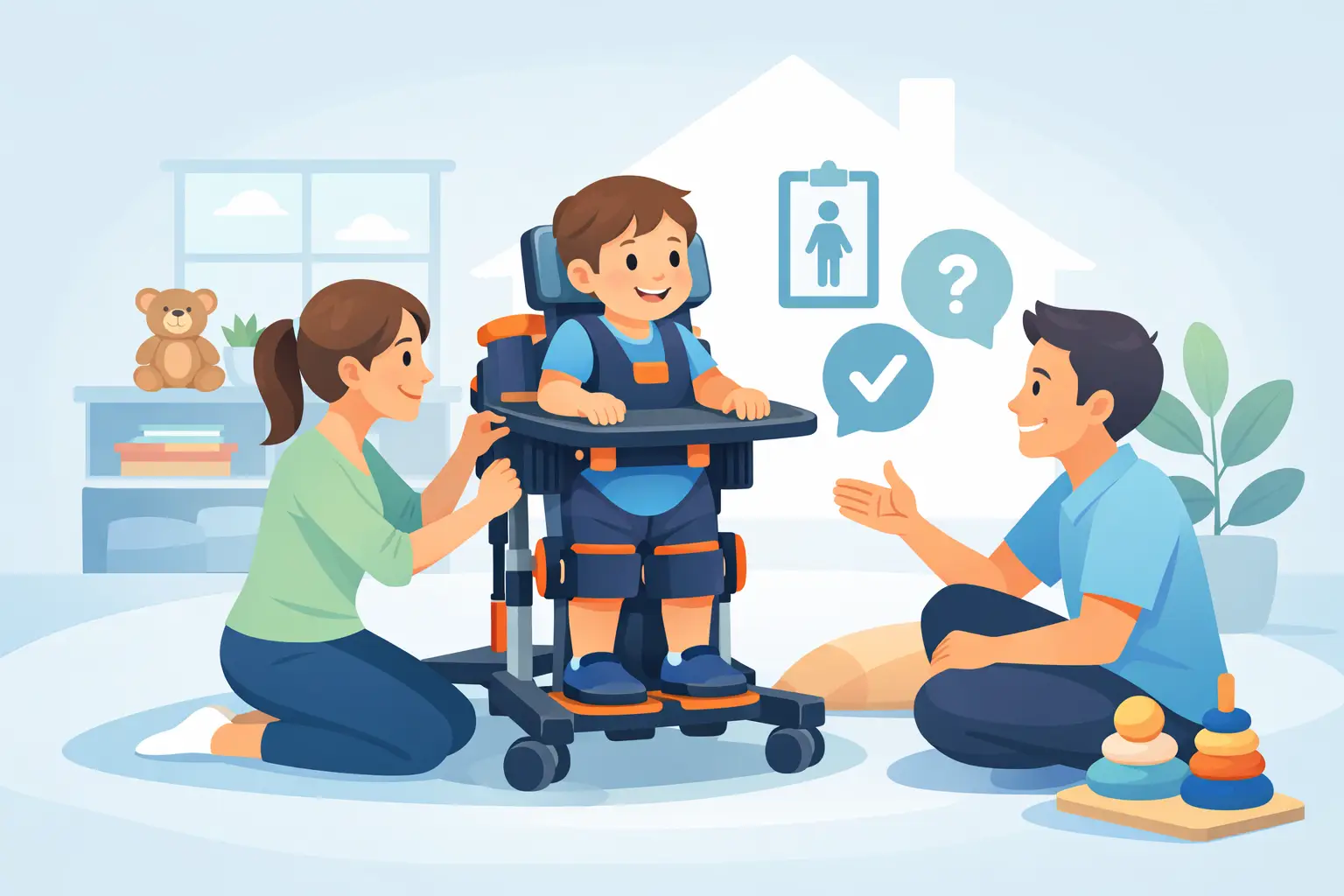
Choosing a Pediatric Stander for Home Therapy
A child may only spend part of the day in a stander, but the equipment choice affects much more than that hour. Transfers, positioning tolerance, caregiver setup time, room layout, and follow-through with a home program all depend on whether the device fits the child and the home environment. Choosing a pediatric stander for home therapy is rarely about one feature alone. It is about matching clinical goals with practical use in daily care.
For caregivers, therapists, and homecare buyers, that means looking beyond product labels like prone, supine, or sit-to-stand and asking a more useful question: what standing program needs to happen at home, and what equipment will make that realistic day after day? A stander that supports proper alignment but is difficult to transfer into may not be used consistently. A model that is easy to move room to room but lacks the right support surfaces may not meet therapeutic goals.
Why a pediatric stander for home therapy needs a careful match
Standing programs are often recommended to support weight bearing, hip development, stretching, trunk control, and participation in activities at eye level. In the home setting, those goals still matter, but so do caregiver workload and available space. The best equipment choice balances therapy intent with repeatable use.
That balance is especially important when multiple people are involved in care. A therapist may set the program, but family members, aides, or school support staff may be the ones using the device every day. If adjustments are complicated or the child outgrows the support range too quickly, the stander can become a source of delay instead of progress.
A well-chosen stander supports consistency. It should help the child maintain alignment, tolerate the recommended duration, and participate in activities such as play, feeding, communication, or schoolwork when appropriate. It should also allow caregivers to position the child safely without excessive strain.
Start with the child’s clinical presentation
The first step is not selecting a frame style. It is understanding the child’s positioning needs. Head control, trunk strength, hip range, knee extension, ankle position, and overall tone pattern all influence what type of support is necessary.
A child with limited head and trunk control may need more anterior or posterior support than a child who can actively maintain midline. A child with significant contracture risk may need more precise lower-extremity positioning and gradual angle changes. If the child has asymmetry, pelvic obliquity, or a tendency to rotate, support surfaces and adjustment points matter more than convenience features.
This is where collaboration with the prescribing therapist or clinician matters. In many cases, the stander should reflect documented goals, not just general standing tolerance. Some children benefit most from prone positioning that encourages active head lifting and upper-extremity use. Others need a supine stander that provides more posterior support and controlled alignment. Sit-to-stand models can work well when transfer efficiency and progressive standing are priorities, but they are not ideal for every body type or every tone pattern.
Types of pediatric standers used in home therapy
A pediatric stander for home therapy generally falls into a few broad categories, each with strengths and trade-offs.
Prone standers place support at the front of the body. They can encourage active extension, head control, and engagement with surfaces in front of the child. They are often useful for children who benefit from a more active standing posture. The trade-off is that some children fatigue more quickly in prone, and transfer setup may be less straightforward depending on the model.
Supine standers support the child from behind and can offer substantial positioning control. They are often considered when a child needs more assistance maintaining alignment or has limited head and trunk control. These models can be a strong option for longer standing tolerance, but they may take up more space and can feel more equipment-intensive in smaller homes.
Sit-to-stand systems begin in a seated position and move the child into standing. For some caregivers, this improves transfer efficiency and reduces lifting demands. These systems can be especially practical for home routines. The trade-off is that not every child achieves the same positioning quality in a sit-to-stand frame as they would in a more specialized prone or supine model.
Multi-position standers offer flexibility as needs change, but flexibility does not automatically mean better fit. More functions can mean more adjustments, more training, and a higher burden on the caregiver. In homecare, simplicity often supports better compliance.
Fit and adjustability matter more than extra features
The stander should fit the child now, with reasonable room for growth, without sacrificing positioning accuracy. Too much growth room can be just as problematic as too little. If pads, trays, knee blocks, or footplates cannot be adjusted precisely enough, alignment may be compromised.
Look closely at pelvic support, trunk supports, knee positioning, foot placement, and head support options. These are not minor accessories. They are central to how well the child is positioned and how comfortably the program can be carried out.
Height and weight capacity are basic starting points, but they are not enough. Measurements such as chest width, hip width, inseam, knee-to-foot length, and support surface height can determine whether the device works in practice. For growing children or those with complex postural needs, small measurement differences can change whether the stander is clinically effective.
Adjustability should also be realistic for the caregiver using it. If every session requires multiple tools, repeated repositioning, or time-consuming strap changes, the standing schedule may become difficult to maintain. In home use, ease of setup is a clinical factor because it directly affects consistency.
Home environment and caregiver use should guide the purchase
A common mistake is selecting a stander based only on clinic performance. Home use introduces different constraints. Doorway width, flooring type, transfer surfaces, storage space, and the child’s daily schedule all affect usability.
If the stander needs to move between rooms, wheelbase size and maneuverability matter. If the child stands during meals, school tasks, or play, tray design and access matter. If storage is limited, the footprint matters. If one caregiver will manage most sessions alone, transfer height and setup sequence matter.
Caregiver safety deserves equal attention. A stander that reduces lifting strain or supports safer transfers can improve long-term success with the therapy plan. That is especially relevant in households where the child is growing, where care is shared by multiple adults, or where aides need a setup that can be taught consistently.
Safety, compliance, and long-term support
Because this is durable medical equipment used in ongoing care, product quality and support should be part of the decision. Buyers should confirm that the stander is appropriate for the intended user profile and that replacement parts, accessories, and setup guidance are available when needed.
This matters for institutional buyers and home purchasers alike. Pediatric positioning equipment often requires follow-up adjustments as the child grows or as clinical goals change. Access to knowledgeable product support can reduce downtime and help caregivers make necessary modifications without guesswork.
It is also worth considering how the stander fits into the broader care plan. Some children use gait trainers, seating systems, orthotics, or transfer aids alongside the stander. Equipment compatibility is not always exact, but the overall workflow should make sense. A stander that works well on its own but complicates the rest of the home program may not be the strongest operational choice.
When the best option depends
There is no single best pediatric stander for home therapy because the right answer depends on the child, the caregiver, and the setting. A highly supportive supine model may be the best clinical solution for one child and an impractical daily burden for another household. A simpler sit-to-stand frame may improve consistency in one home while offering too little support in another.
That is why product selection should be grounded in function, not assumptions. What position is being targeted? How long is the child expected to stand? Who will set up the equipment? How often will it be used? Will it stay in one room or move throughout the home? Those questions usually reveal the right direction faster than comparing feature lists alone.
For buyers managing sourcing across pediatric rehab categories, it also helps to work with a supplier that understands both clinical equipment requirements and homecare logistics. DME Medical Supplies supports that process with broad product access and expert guidance designed to help customers identify practical solutions without slowing down care.
The right stander should do more than meet a specification sheet. It should make the home therapy plan easier to carry out safely, consistently, and with enough flexibility to support the child’s progress over time.